

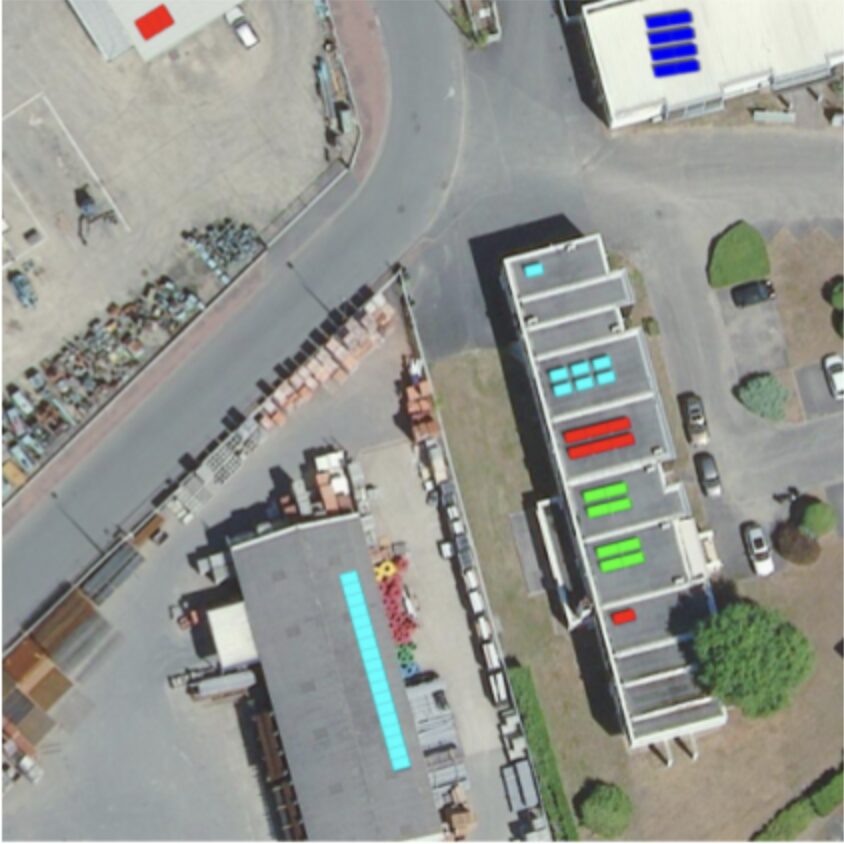
What is Reverie? Reverie is Another Earth’s proprietary synthetic data engine. It generates highly realistic satellite imagery with perfect labels automatically attached at the moment of creation, eliminating the need for expensive and time-consuming manual annotation.
Solving Data Scarcity When building Earth Observation models, teams often hit a wall: the real data they need is usually unlabeled, lacks specific information, or simply doesn’t exist. With Reverie, we can simulate the exact region, specific events or surface properties, and sensor characteristics needed on demand. Whether a project requires mapping complex, densely packed urban environments or monitoring remote forests, Reverie seamlessly fills the gaps where real archives run thin.
Reverie works with all bands and across a wide range of sensors, from 10m Sentinel data to 25cm drone and aerial imagery. Alongside the imagery and its segmentation masks, it also supplies DSM information. And because the data is generated, it lowers the costs of buying and processing archive data in the first place.
Proven Data Efficiency Reverie’s central benefit is drastically reducing the amount of manual ground truth required to train a reliable model. When training a model on a small dataset versus a large one, teams often encounter a lower model accuracy due to insufficient training. Reverie helps teams maintain model accuracy by generating synthetic satellite data to fill gaps when real training data is missing. Additionally, synthetically generated data even makes it possible to slightly increase model accuracy when added to an already complete real dataset.
In a rigorous land cover segmentation test, we quantified exactly how well synthetic data substitutes for real data:
The Bottom Line While a small fraction of real data is still necessary to ground the AI, Reverie proves that high-level performance is achievable with significantly less manually labeled imagery. It removes the biggest bottleneck limiting modern EO projects, ensuring teams can build accurate models regardless of how sparse the real data archive is.