

In recent years global cocoa prices have risen sharply, with 2024 reaching an all-time high, above 11,000 € per tonne. These swings trace back to production problems in the major cocoa- producing countries, many of them caused by plant diseases that spread rapidly through plantations and inflict heavy losses, threatening both livelihoods and the stability of the supply chain. Côte d’Ivoire and Ghana, the two heavyweight producers that together account for around two thirds of global cocoa, have seen yields fall even as they expand the area under cultivation.
One disease that affects cocoa in particular is the Cocoa Swollen Shoot Virus Disease (CSSVD). It is hard to catch early, spreads fast and, once established, can cut a plantation’s yield by around half. The challenge is finding it before it spreads, since traditional in-field detection is reactive and labour-intensive. Existing EO-based methods come with their own limits: they often lack the high-resolution data, the training sets and the continuity that effective monitoring needs.
Together with our partners we are developing CoMPASS (Cocoa Monitoring and Productivity Assessment System), a system built to close exactly those gaps.Its aim is to catch CSSVD before an outbreak, through EO-based services for plantation monitoring, early risk detection and yield estimation.
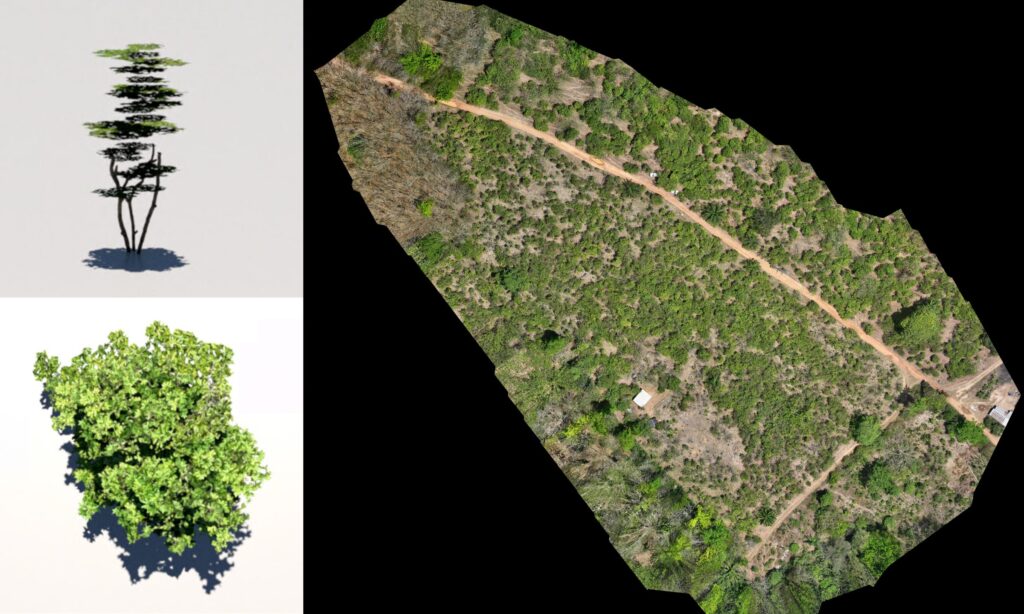
The system pulls together several data sources into one continuous read on each plantation. It combines optical and radar satellite imagery, from Sentinel-2 and the BIOMASS radar mission to very high-resolution scenes, with drone surveys and field observations, and fills the gaps in the disease record with synthetic training data where real labelled examples are missing. From these inputs CoMPASS tracks the signs that give away a plantation’s condition: vegetation stress, tree density, shade cover and the structure of the surrounding agroforestry. Reading these across successive satellite passes through time-series analysis of the vegetation signal, the system separates the early signature of an outbreak from the ordinary swing of the seasons,so growers can act while a field can still be saved.
CoMPASS brings together three partners, each covering a different part of the problem. Beetle ForTech coordinates the project and runs the fieldwork in Côte d’Ivoire, bringing its knowledge of the agroforestry market and its tools for EU Deforestation Regulation compliance. Joanneum Research develops the Earth Observation and AI monitoring behind the system, drawing on its Digital Twin work. Our role, at Another Earth, is the synthetic training data that teaches the models what the disease looks like from above. Together, the project works toward cocoa supply held steadier and growers’ incomes protected, with less pressure on the fragile agroforestry systems the crop depends on.